10 - Seafloor Grids
An adaptation of agegrid-0.1 written by Simon Williams, Nicky Wright and John Cannon for gridding general z-values onto seafloor basin points using GPlately.
This notebook demonstrates how to generate seafloor age and spreading-rate grids through time. The figure below, generated by this notebook, shows seafloor age at 65 Ma. You may adjust the time parameter to generate grids at different geological times.
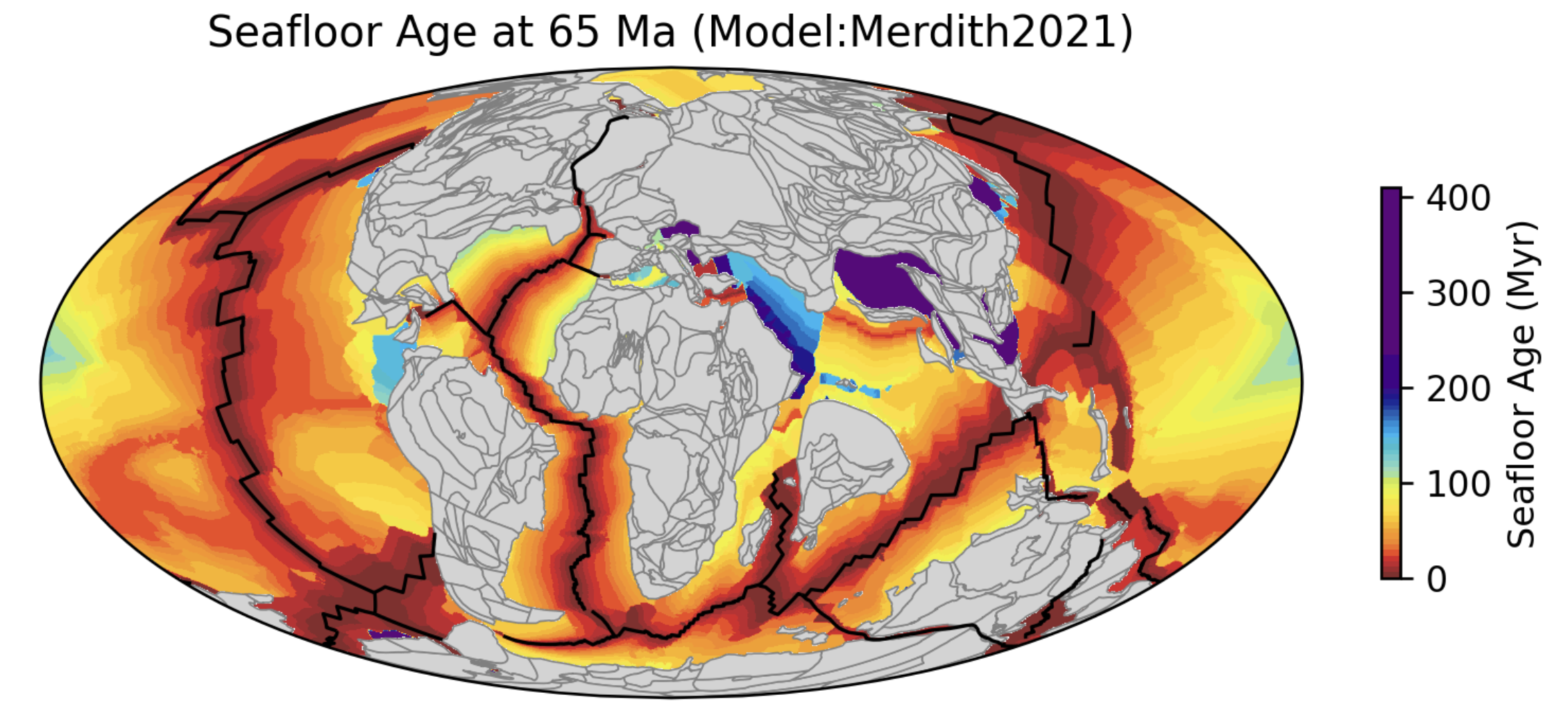
Citation:
Simon Williams, Nicky M. Wright, John Cannon, Nicolas Flament, R. Dietmar Müller, Reconstructing seafloor age distributions in lost ocean basins, Geoscience Frontiers, Volume 12, Issue 2, 2021, Pages 769-780, ISSN 1674-9871, https://doi.org/10.1016/j.gsf.2020.06.004.
import os
os.environ["GPLATELY_DISABLE_DEV_WARNING"] = "true"
#
# Setting GPLATELY_DEBUG to a value above 100 will create the following debug files
# during seafloor gridding (that can be loaded into GPlates):
#
# - A separate debug file for each time (from 'max_time' to 'min_time') containing the seed points
# reconstructed from that time to 'min_time'.
# * The debug file with "initial_ocean_basin" in the filename contains reconstructions of the initial ocean basin seed points, and
# * each debug file with "mid_ocean_ridge" in the filename contains reconstructions of the seed points created along mid-ocean ridges
# that formed at that time specified in the filename.
# - One big debug file containing the reconstructions of ALL seed points created at ALL times.
#
# These files are located in the 'debug' sub-directory of the save directory.
#
# os.environ["GPLATELY_DEBUG"] = "200"
import gplately
import glob, warnings, io, zipfile
from pathlib import Path
import matplotlib.pyplot as plt
import cartopy.crs as ccrs
from plate_model_manager import PlateModelManager
import requests
from gplately import IsochronSeafloorGrid, OutputScalarType, TopologySeafloorGrid
from gplately.auxiliary import get_gplot
from gplately.plot import get_age_grid_cmap, get_spreading_rate_cmap
warnings.filterwarnings("ignore", category=UserWarning)
warnings.filterwarnings("ignore", category=RuntimeWarning)
data_dir = Path("WorkflowData/10-Seafloor-Grids")
output_dir = data_dir / "output"
output_dir.mkdir(parents=True, exist_ok=True)
Matplotlib is building the font cache; this may take a moment.
Define a rotation model, topology features and continents for the PlateReconstruction model
There are two ways to do this. To use local files, set use_local_files = True. To use PlateModelManager, set use_local_files = False.
use_local_files = False
1) Manually pointing to files
if use_local_files:
# Method 1: manually point to files
# you can download the model files at
# https://www.earthbyte.org/webdav/ftp/Data_Collections/Merdith_etal_2021_ESR/SM2-Merdith_et_al_1_Ga_reconstruction_v1.2.4.zip
input_directory = "./SM2-Merdith_et_al_1_Ga_reconstruction_v1.2.4"
rotation_model = glob.glob(os.path.join(input_directory, "*.rot"))
static_polygons = input_directory + "/shapes_static_polygons_Merdith_et_al.gpml"
topology_features = [
input_directory + "/250-0_plate_boundaries_Merdith_et_al.gpml",
input_directory + "/410-250_plate_boundaries_Merdith_et_al.gpml",
input_directory + "/1000-410-Convergence_Merdith_et_al.gpml",
input_directory + "/1000-410-Divergence_Merdith_et_al.gpml",
input_directory + "/1000-410-Topologies_Merdith_et_al.gpml",
input_directory + "/1000-410-Transforms_Merdith_et_al.gpml",
input_directory + "/TopologyBuildingBlocks_Merdith_et_al.gpml",
]
continents = input_directory + "/shapes_continents.gpml"
coastlines = input_directory + "/shapes_coastlines_Merdith_et_al_v2.gpmlz"
COBs = None
from pathlib import Path
if not Path(input_directory).is_dir():
raise FileNotFoundError(
f"The input directory does not exist: {input_directory}. Ensure your files are in the correct locations or download the example input files at https://www.earthbyte.org/webdav/ftp/Data_Collections/Merdith_etal_2021_ESR/SM2-Merdith_et_al_1_Ga_reconstruction_v1.2.4.zip"
)
2) Using PlateModelManager
if not use_local_files:
# Method 2: use PlateModelManager
pmm_model = PlateModelManager().get_model(
"Merdith2021", data_dir="plate-model-repo"
)
assert pmm_model is not None, "Failed to load the Merdith2021 plate model."
rotation_model = pmm_model.get_rotation_model()
topology_features = pmm_model.get_topologies()
static_polygons = pmm_model.get_static_polygons()
continents = pmm_model.get_layer("ContinentalPolygons")
The TopologySeafloorGrid object
...is a collection of methods to generate seafloor grids.
The critical input parameters are:
Plate model parameters
plate_reconstruction: The gplatelyPlateReconstructionobject defined in the cell below. This object is a collection of methods for calculating plate tectonic stats through geological time.plot_topologies: The gplatelyPlotTopologiesobject defined in the cell below. This object is a collection of methods for resolving geological features needed for gridding to a certain geological time.
Define the PlateReconstruction and PlotTopologies objects
model = gplately.PlateReconstruction(rotation_model, topology_features, static_polygons)
gplot = gplately.PlotTopologies(model, continents=continents)
Time parameters
max_time: The first time step to start generating age grids. This is the time step where we define certain gridding initial conditions, which will be explained below.min_time: The final time step to generate age grids. This is the time when recursive reconstructions starting frommax_timestop.
max_time = 410.0
min_time = 65.0
Ridge resolution parameters
With each reconstruction time step, mid-ocean ridge segments emerge and spread across the ocean floor. In gplately, these ridges are lines, or a tessellation of infinitesimal points. The spatio-temporal resolution of these ridge points can be controlled by two parameters:
ridge_time_step: The "delta time" or time increment between successive resolutions of ridges, and hence successive grids. By default this is 1Myr, so grids are produced every millionth year.ridge_sampling: This controls the geographical resolution (in degrees) with which ridge lines are partitioned into points. The larger this is, the larger the spacing between successive ridge points, and hence the smaller the number of ridge points at each timestep. By default this is 0.5 degrees, so points are spaced 0.5 degrees apart.
ridge_time_step = 5.0 # We set the time step to 5 Myr to reduce the notebook’s runtime.
ridge_sampling = 0.5
Grid resolution parameters
The ridge resolution parameters mentioned above take care of the spatio-temporal positioning of ridge features/points. However, these ridge points need to be interpolated onto regular grids - separate parameters are needed for these grids.
For the max_time initial condition
At max_time, i.e. 410Ma, the PlateReconstruction model has not been initialised at 411Ma and any time(s) before that to sculpt the geological history before max_time. In terms of the workflow, all geological history before max_time is unknown. Thus, the global seafloor point distribution, and each point's spreading rate and age must be manually defined.
The initial point distribution is an icosahedral point mesh.
refinement_levels: A unitless integer that controls the number of points in themax_timeicosahedral point mesh.6 is the default. Any higher will result in a finer mesh.
initial_ocean_mean_spreading_rate(in units of mm/yr or km/myr): Since the geological history before and atmax_timeis unknown, we will need to manually define the spreading rates and ages of all ocean points. This is manually set to a uniform spreading rate of 50 (mm/yr or km/myr). Each point's age is equal to its proximity to the nearest mid ocean ridge (assuming that ridge is the source of the point) divided by half this uniform spreading rate (half to account for spreading to the left and right of a ridge).
For the interpolated regular grids
The regular grid on which all data is interpolated has a resolution that can be controlled by:
grid_spacing: The degree spacing between successive nodes in the grid. By default, this is 0.1 degrees. Acceptable degree spacings are 0.1, 0.25, 0.5, 0.75, or 1 degree(s) because these allow cleanly divisible grid nodes across global latitude and longitude extents. Anything greater than 1 will be rounded to 1, and anything between these acceptable spacings will be rounded to the nearest acceptable spacing.
refinement_levels = 6
initial_ocean_mean_spreading_rate = 50.0
# Gridding parameter
grid_spacing = 0.25
extent = (-180, 180, -90, 90)
File saving and naming parameters
When grids are produced, they are saved to:
save_directory: A string to a directory that must exist already.
These files are named according to:
file_collection: A string used to help with naming all output files.
# continent masks, initial ocean seed points, and gridding input files are kept here
output_parent_directory = output_dir
save_directory = output_parent_directory / "seafloor_grids"
print(
f"The output files created by this notebook will be saved in folder {save_directory}."
)
# A string to help name files according to a plate model "Merdith2021"
file_collection = "Merdith2021"
The output files created by this notebook will be saved in folder WorkflowData/10-Seafloor-Grids/output/seafloor_grids.
Continent collision
One way an oceanic point can be deleted from the ocean basin at a certain timestep is if it is collides into continental crust. At each timestep continental crust is represented as a continental mask which is a binary grid that partitions continental regions from oceanic regions. By default, continental masks are generated from the reconstructed continental polygons (where the continent polygons features are specified with continent_polygon_features). But they can also be generated using continent contouring (by specifying use_continent_contouring=True) or you can explicitly provide them as your own continent masks (by specifying them with continent_mask_filename).
Subduction parameters
Another way an oceanic point can be deleted from the ocean basin at a certain timestep is if it is approaching a plate boundary such that a velocity and displacement test is passed:
Velocity test
First, given the trajectory of a point at the next time step, a point will cross a subducting plate boundary (and thus will be deleted) if the difference between its velocity on its current plate and the velocity it would have on the other plate is higher than a specified threshold delta velocity in km/Myr.
Displacement test
If the proximity of the point's previous time position to the plate boundary it is approaching is higher than a set distance threshold (threshold distance to boundary per Myr in km/Myr), then the point is far enough away from the boundary that it cannot be subducted or consumed by it, and hence the point is still active.
The parameter needed to encapsulate these thresholds is:
subduction_collision_parameters: This is a tuple with two elements, by default (5.0, 10.0), for the (threshold velocity delta in km/Myr, threshold distance to boundary per Myr in km/Myr)
continent_polygon_features = continents
subduction_collision_parameters = (5.0, 10.0)
Methodology parameters
resume_from_checkpoints: Gridding can take a while (depending on the number of CPUs used). If this is changed toTrue, after gridding was interrupted, then rerunning the gridding cell will resume from where it left off.nprocs: The number of CPUs to use for parts of the code that are parallelized. The default is-2which uses all CPUs except one (to keep the system responsive).
# Methodology parameters
resume_from_checkpoints = False
nprocs = -2
Use all parameters to define TopologySeafloorGrid:
# The TopologySeafloorGrid object with all aforementioned parameters
topology_seafloor_grid = gplately.TopologySeafloorGrid(
plate_reconstruction=model,
# Time parameters
max_time=max_time,
min_time=min_time,
# Ridge tessellation parameters
ridge_time_step=ridge_time_step,
ridge_sampling=ridge_sampling,
# Gridding parameters
grid_spacing=grid_spacing,
extent=extent,
# Naming parameters
save_directory=save_directory,
file_collection=file_collection,
# Initial condition parameters
refinement_levels=refinement_levels,
initial_ocean_mean_spreading_rate=initial_ocean_mean_spreading_rate,
# Subduction parameters
subduction_collision_parameters=subduction_collision_parameters,
# Methodology parameters
resume_from_checkpoints=resume_from_checkpoints,
# Continental polygons.
continent_polygon_features=continent_polygon_features,
nprocs=nprocs,
)
How to use TopologySeafloorGrid
1) Run topology_seafloor_grid.generate(use_topological_model=True)
Running topology_seafloor_grid.generate(use_topological_model=True) prepares all ocean basin points and their seafloor ages and spreading rates for gridding, and reconstructs all active points per timestep to form the grids per timestep. Internally, this uses pygplates.TopologicalModel to perform the reconstruction; pass use_topological_model=False instead to use the pure-Python reconstruct_by_topologies() implementation.
Continental masks
A netCDF4 continent mask is produced for each time from max_time to min_time.
Initial ocean basin
At max_time, an initial ocean seed point icosahedral mesh fills the ocean basin. Each initial seed point is allocated an age based on its distance from the nearest mid-ocean ridge. And these are reconstructed to min_time to produce an .npz file (containing reconstructed seed point data for seed points created at max_time).
Mid-ocean ridges
At each successive timestep (ridge_time_step), new seed points emerge from spreading ridges, and they are allocated their own spreading rates. The seed points emerging at a particular time are reconstructed to min_time to produce an .npz file (containing reconstructed seed point data for seed points created at that time). This results in one .npz file for each time from max_time - ridge_time_step to min_time.
Seafloor age and spreading rate
After all seed points (initial and mid-ocean ridge) have been reconstructed to min_time, then one .npz file is generated for each time from max_time to min_time. These files contain the gridding input that will later be used to generate the seafloor age and spreading rate grids.
Resuming an interrupted gridding run
If the resume_from_checkpoints parameter is passed as True, after topology_seafloor_grid.generate(use_topological_model=True) was interrupted, then you can rerun the cell. The workflow will pick up from where it left off (provided the continent mask files and reconstructed seed point data files have not been erased).
To overwrite all files in save_directory, pass resume_from_checkpoints as False (this is the default behaviour).
Reconstruct by topologies
The ReconstructByTopologies object (written by Simon Williams, Nicky Wright, and John Cannon) handles the reconstruction of seed points. ReconstructByTopologies (RBT) identifies active points on the ocean basin per timestep. It works as follows:
If an ocean point on one plate ID transitions into another rigid plate ID at the next timestep, RBT calculates the point's velocity difference between both plates. The point may have subducted/collided with a continent at this boundary if this velocity difference is higher than a set velocity threshold. To ascertain whether the point should indeed be deactivated, a second test is conducted: RBT checks the previous time position of the point and calculates this point’s proximity to the boundary of the plate ID polygon it is approaching. If this distance is higher than a set distance threshold, then the point is far enough away from the boundary that it cannot be subducted or consumed by it and hence the point is still active. Else, it is deactivated/deleted.
Once all active points and their z-values are identified, they are written to the gridding input file (.npz) for that timestep.
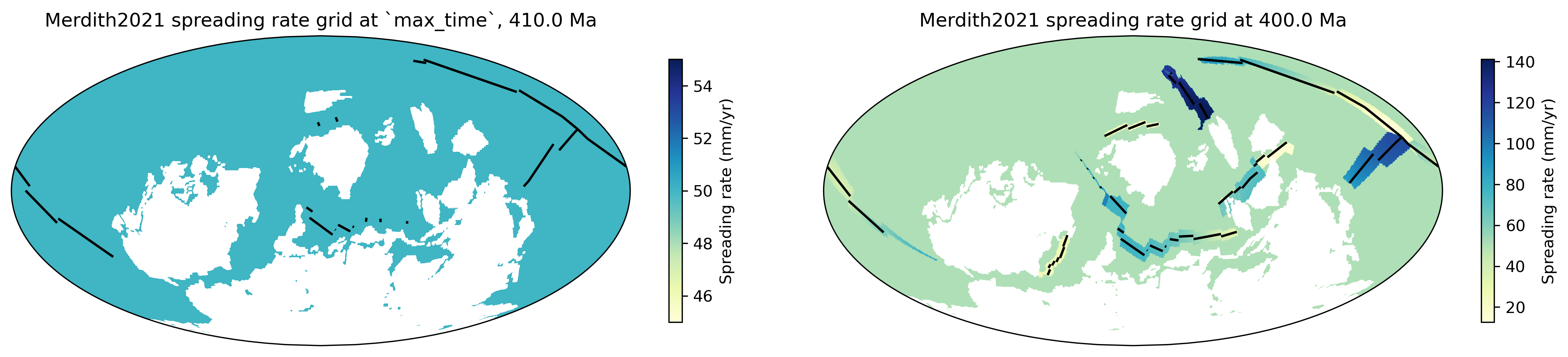
Below is an example of the initial condition: the ocean basin is populated with an initial_ocean_mean_spreading_rate of 50 mm/yr at a max_time of 410Ma. Reconstruction over 10 Myr to 400 Ma sees new seed points emerging from ridges with their own plate-model-ascribed spreading rates.
from IPython.display import clear_output
import datetime
import time
start = time.time()
topology_seafloor_grid.generate(use_topological_model=True)
end = time.time()
duration = datetime.timedelta(seconds=end - start)
clear_output(wait=True)
print(f"Finished creating seafloor grids.")
Finished creating seafloor grids.
2) Run topology_seafloor_grid.lat_lon_z_to_netCDF to write grids to netCDF
Calling topology_seafloor_grid.lat_lon_z_to_netCDF grids one set of z-data per latitude-longitude pair from each timestep's gridding input file (produced in topology_seafloor_grid.generate(use_topological_model=True)). Grids are in netCDF format.
The desired z-data to grid is identified using a zval_name.
For example, seafloor age grids can be produced using SEAFLOOR_AGE, and spreading rate grids are SPREADING_RATE.
Use unmasked = True to output both the masked and unmasked versions of the grids.
topology_seafloor_grid.lat_lon_z_to_netCDF("SEAFLOOR_AGE", unmasked=True)
clear_output()
topology_seafloor_grid.lat_lon_z_to_netCDF("SPREADING_RATE", unmasked=True)
clear_output()
Plotting a sample age grid and spreading rate grid
Read one netCDF grid using GPlately's Raster object from grids, and plot it using the PlotTopologies object.
Notice the evolution of seafloor spreading rate from the initial value set with initial_ocean_mean_spreading_rate. Eventually, this initial uniform spreading rate will be phased out with sufficient recursive reconstruction.
time = min_time
# set the plot_unmasked_grid variable to True if you would like to see the unmasked age grid.
plot_unmasked_grid = False
# age grids
if not plot_unmasked_grid:
agegrid_filename = f"{topology_seafloor_grid.save_directory}/SEAFLOOR_AGE/{topology_seafloor_grid.file_collection}_SEAFLOOR_AGE_grid_{time:0.2f}Ma.nc"
else:
agegrid_filename = f"{topology_seafloor_grid.save_directory}/SEAFLOOR_AGE/{topology_seafloor_grid.file_collection}_SEAFLOOR_AGE_grid_unmasked_{time:0.2f}Ma.nc"
age_grid = gplately.Raster(agegrid_filename)
# Prepare plots
fig = plt.figure(figsize=(8, 4), dpi=240, linewidth=1)
ax = fig.add_subplot(111, projection=ccrs.Mollweide(central_longitude=20))
gplot.time = time
plt.title(f"Seafloor Age at {int(time)} Ma (Model: {topology_seafloor_grid.file_collection})")
agegrid_cmap = "YlGnBu"
try:
agegrid_cmap = get_age_grid_cmap()
except Exception as e:
print("Failed to get the built-in age grid colormap. Use {agegrid_cmap} instead.")
print(e)
im = gplot.plot_grid(
ax,
age_grid.data,
cmap=agegrid_cmap,
vmin=0,
vmax=410,
)
gplot.plot_all_topological_sections(
ax,
plot_subduction_teeth=True,
other_kwargs={"color": "grey", "linewidth": 0.7},
ridge_kwargs={"color": "black", "linewidth": 0.7},
transform_kwargs={"color": "green", "linewidth": 0.7},
trench_kwargs={"color": "blue", "linewidth": 0.7},
)
if not plot_unmasked_grid:
gplot.plot_continents(ax, edgecolor="grey", facecolor="lightgrey", linewidth=0.5)
plt.colorbar(im, label="Seafloor Age (Myr)", shrink=0.5, pad=0.05)
# Save figure
plt.savefig(
f"{output_parent_directory}/{topology_seafloor_grid.file_collection}_seafloor_age_{int(time)}Ma.png",
bbox_inches="tight",
)
plt.show()

time = min_time
# set the plot_unmasked_grid variable to True if you would like to see the unmasked spreading rate grid.
plot_unmasked_grid = False
# spreading rate grids
if not plot_unmasked_grid:
srgrid_filename = f"{topology_seafloor_grid.save_directory}/SPREADING_RATE/{topology_seafloor_grid.file_collection}_SPREADING_RATE_grid_{time:0.2f}Ma.nc"
else:
srgrid_filename = f"{topology_seafloor_grid.save_directory}/SPREADING_RATE/{topology_seafloor_grid.file_collection}_SPREADING_RATE_grid_unmasked_{time:0.2f}Ma.nc"
sr_grid = gplately.Raster(srgrid_filename)
# Prepare plots
fig = plt.figure(figsize=(8, 4), dpi=240, linewidth=1)
ax = fig.add_subplot(111, projection=ccrs.Mollweide(central_longitude=20))
gplot.time = time
plt.title(
f"Seafloor Spreading Rate at {int(time)} Ma (Model: {topology_seafloor_grid.file_collection})"
)
spreading_rate_cmap = "magma"
try:
spreading_rate_cmap = get_spreading_rate_cmap()
except Exception as e:
print("Failed to get the built-in spreading rate grid colormap. Use {spreading_rate_cmap} instead.")
print(e)
im = gplot.plot_grid(
ax,
sr_grid.data,
cmap=spreading_rate_cmap,
vmin=0,
vmax=200,
)
gplot.plot_all_topological_sections(
ax,
plot_subduction_teeth=True,
other_kwargs={"color": "grey", "linewidth": 0.7},
ridge_kwargs={"color": "black", "linewidth": 0.7},
transform_kwargs={"color": "green", "linewidth": 0.7},
trench_kwargs={"color": "blue", "linewidth": 0.7},
)
if not plot_unmasked_grid:
gplot.plot_continents(ax, edgecolor="grey", facecolor="lightgrey", linewidth=0.5)
plt.colorbar(
im,
label="Spreading rate (mm/yr)",
shrink=0.5,
pad=0.05,
ticks=[0, 50, 100, 150, 200],
)
# Save figure
plt.savefig(
f"{output_parent_directory}/{topology_seafloor_grid.file_collection}_seafloor_spreading_rate_{int(time)}Ma.png",
bbox_inches="tight",
)
plt.show()

Generate Seafloor Grids Using Isochron Interpolation
age_grid_input_dir = data_dir / "AgeGridInput"
isochron_grid_times = [0, 50, 100, 200]
isochron_grid_dir = output_dir / "isochron-grids"
if not os.path.isdir(age_grid_input_dir):
# download the isochron file if not exists
r = requests.get(
"https://repo.gplates.org/webdav/gplately/AgeGridInput.zip",
allow_redirects=True,
)
if r.status_code in [200]:
z = zipfile.ZipFile(io.BytesIO(r.content))
z.extractall(data_dir)
gplot = get_gplot("zahirovic2022", model_repo_dir="plate-model-repo")
IsochronSeafloorGrid(
plate_reconstruction=gplot.plate_reconstruction,
time_steps=isochron_grid_times,
ridges=f"{age_grid_input_dir}/Global_EarthByte_GeeK07_Ridges.gpml",
isochrons=f"{age_grid_input_dir}/Global_EarthByte_GeeK07_Isochrons.gpml",
iso_cob=f"{age_grid_input_dir}/Global_EarthByte_GeeK07_IsoCOB.gpml",
continental_polygons=f"{age_grid_input_dir}/Global_EarthByte_GeeK07_COB_Terranes_ContinentsOnly.gpml",
interval_spacing_degrees=0.5,
grid_output_dir=isochron_grid_dir,
).generate(set([OutputScalarType.AGE, OutputScalarType.SPREADING_RATE]))
print(f"Finished generating isochron seafloor grids.")
2026-09-14 02:14:55 - gplately - INFO - Current reconstruction time is 0 Ma
2026-09-14 02:15:35 - gplately - INFO - Generating continent mask grid...
2026-09-14 02:15:36 - gplately - INFO - Running sphinterpolate for Age at 0 Ma
2026-09-14 02:15:56 - gplately - INFO - Running sphinterpolate for SpreadingRate at 0 Ma
2026-09-14 02:16:14 - gplately - INFO - Current reconstruction time is 50 Ma
2026-09-14 02:16:48 - gplately - INFO - Generating continent mask grid...
2026-09-14 02:16:48 - gplately - INFO - Running sphinterpolate for Age at 50 Ma
2026-09-14 02:17:03 - gplately - INFO - Running sphinterpolate for SpreadingRate at 50 Ma
2026-09-14 02:17:15 - gplately - INFO - Current reconstruction time is 100 Ma
2026-09-14 02:17:56 - gplately - INFO - Generating continent mask grid...
2026-09-14 02:17:56 - gplately - INFO - Running sphinterpolate for Age at 100 Ma
2026-09-14 02:18:06 - gplately - INFO - Running sphinterpolate for SpreadingRate at 100 Ma
2026-09-14 02:18:16 - gplately - INFO - Current reconstruction time is 200 Ma
2026-09-14 02:18:53 - gplately - INFO - Generating continent mask grid...
2026-09-14 02:18:54 - gplately - INFO - Running sphinterpolate for Age at 200 Ma
2026-09-14 02:19:00 - gplately - INFO - Running sphinterpolate for SpreadingRate at 200 Ma
Finished generating isochron seafloor grids.
def plot_isochron_grids(
scalar_name,
value_label,
cmap,
vmin,
vmax,
colorbar_kwargs=None,
):
fig, axes = plt.subplots(
2,
2,
figsize=(12, 8.5),
dpi=180,
subplot_kw={"projection": ccrs.Mollweide(central_longitude=20)},
constrained_layout=True, # replaces tight_layout(); reserves space for
# suptitle + colorbar automatically instead of
# laying them out first and hoping nothing clips
)
axes = axes.ravel()
cb = None
for ax, time in zip(axes, isochron_grid_times):
grid_path = (
isochron_grid_dir
/ f"isochron_seafloor_{scalar_name}"
/ "Masked"
/ f"seafloor_{scalar_name}_grid_masked_{time}Ma.nc"
)
grid = gplately.Raster(grid_path)
gplot.time = time
cb = gplot.plot_grid(ax, grid.data, cmap=cmap, vmin=vmin, vmax=vmax)
gplot.plot_all_topological_sections(
ax,
plot_subduction_teeth=True,
other_kwargs={"color": "grey", "linewidth": 0.7},
ridge_kwargs={"color": "black", "linewidth": 0.7},
transform_kwargs={"color": "green", "linewidth": 0.7},
trench_kwargs={"color": "blue", "linewidth": 0.7},
)
gplot.plot_continents(
ax, edgecolor="grey", facecolor="lightgrey", linewidth=0.3
)
# smaller font + small pad keeps the title from crowding the map below it
ax.set_title(f"{value_label} at {time} Ma", fontsize=10, pad=4)
if cb is not None:
colorbar_settings = dict(
orientation="horizontal",
location="bottom",
shrink=0.6, # horizontal bars read better shorter/wider than vertical ones
aspect=35, # keeps it slim (width:height ratio) instead of a fat bar
pad=0.05,
)
colorbar_settings.update(colorbar_kwargs or {})
fig.colorbar(cb, ax=axes.tolist(), label=value_label, **colorbar_settings) # type: ignore
fig.suptitle(f"Seafloor {value_label}", fontsize=14)
plt.show()
plot_isochron_grids(
"age",
"Age (Myr)",
agegrid_cmap,
0,
410,
)
plot_isochron_grids(
"spreading_rate",
"Spreading Rate (mm/yr)",
spreading_rate_cmap,
0,
200,
colorbar_kwargs={"ticks": [0, 50, 100, 150, 200]},
)


Seafloor Gridding CLI
GPlately provides a command line interface for generating seafloor grids, such as seafloor age, spreading rate, and other derived quantities.
The easiest way to run the command is with a TOML configuration file:
gplately ag seafloor-grids-output --config tests-dir/unittest/gplately-cli-config.toml
Several example TOML configuration files are included:
tests-dir/unittest/gplately-cli-config.tomltests-dir/unittest/isochron-seafloor-gridding-1.tomltests-dir/unittest/isochron-seafloor-gridding-2.tomltests-dir/unittest/topology-seafloor-gridding-1.tomltests-dir/unittest/topology-seafloor-gridding-2.toml
Alternatively, run gplately ag --help to see all available arguments and usage examples directly in the terminal.